
Deepening Containment: How Structure Replaces Chaos

Containment is not an abstract concept for me.
It is something I had to construct because it did not exist around me.
I grew up in an environment where unpredictability was the baseline.
Noise, volatility, and emotional instability were the atmosphere.
There was no frame, no rhythm, and no boundary that held.
In that kind of environment, the nervous system learns one thing:
survival through hypervigilance.
Containment became the architecture I built to replace the chaos I was given.
Not as a coping mechanism, but as a structural necessity.
This is why I teach containment the way I do:
not as restriction, not as withdrawal, but as the precondition for reorganisation.
Why Containment Matters More Than People Realise
Containment is not about shrinking your life.
It is about removing the noise that keeps the nervous system in a defensive state.
When the field is too wide:
the brain scans instead of builds
vigilance replaces clarity
energy is spent on threat detection
identity becomes reactive
deeper circuits never engage
Containment narrows the field so the system can finally see itself.
This is not psychological.
It is architectural.
My Experience of Containment
When I first began to use containment deliberately, I noticed three things:
1. Noise dropped before clarity appeared
The absence of chaos felt unfamiliar.
The system had to learn that quiet was not danger.
2. Patterns emerged that were previously invisible
Once the noise fell away, the underlying architecture of my behaviour became obvious.
3. Identity stabilised
Not because I “found myself,”
but because the system finally had a frame to build within.
Containment did not make me smaller.
It made me coherent.
Why Containment Feels Uncomfortable at First
Containment removes the stimulation that once masked discomfort.
It reveals:
avoidance patterns
overextension
emotional residue
unintegrated states
structural gaps
This exposure is not a problem.
It is the beginning of reorganisation.
The nervous system cannot rebuild what it cannot see.
Containment Practices
These are not self‑care exercises.
They are structural interventions that change the conditions the nervous system operates within.
1. The Narrowed Field Protocol
Reduce the number of active inputs.
Choose one:
one room
one task
one sensory channel
one priority
one person
one project
Hold that narrowed field for ten to twenty minutes.
This teaches the system:
predictability
reduced load
single‑channel processing
safety through simplicity
This is the fastest way to reduce vigilance.
2. The Rhythm Anchor
Introduce a predictable temporal pattern.
Choose a rhythm:
the same chair
the same time
the same route
the same opening action (for example, opening a notebook, switching on a light, or taking one breath)
Repeat it daily.
Rhythm is the nervous system’s first language of safety.
3. The Boundary Line Exercise
Define what is inside the frame and what is outside it.
Write two lists:
Inside the frame today:
three to five items onlyOutside the frame today:
everything else
This is not productivity.
It is neural containment.
The brain needs to know what it is not responsible for.
4. The Sensory Reduction Window
Remove stimulation to reveal underlying patterns.
For five minutes:
no telephone
no conversation
no music
no scrolling
no input
Just sit in a reduced sensory field.
This exposes:
tension
avoidance
unmet needs
structural misalignment
The system cannot reorganise what it cannot perceive.
5. The Contained Environment Reset
Stabilise the external world to stabilise the internal one.
Choose one:
clear one surface
organise one drawer
reset one room
remove one source of noise
Environmental order reduces neural cost.
What These Practices Build
Over time, containment practices create:
lower vigilance
clearer perception
stable identity signals
predictable internal states
access to deeper processing
energy conservation
structural coherence
Containment is not about shrinking your life.
It is about building the architecture that allows your life to expand without collapse.
Containment is the nervous system’s architecture of truth.
When the field narrows and rhythm holds, the system stops defending and begins to reorganise.
Containment is not restriction — it is the structure through which transformation becomes possible.
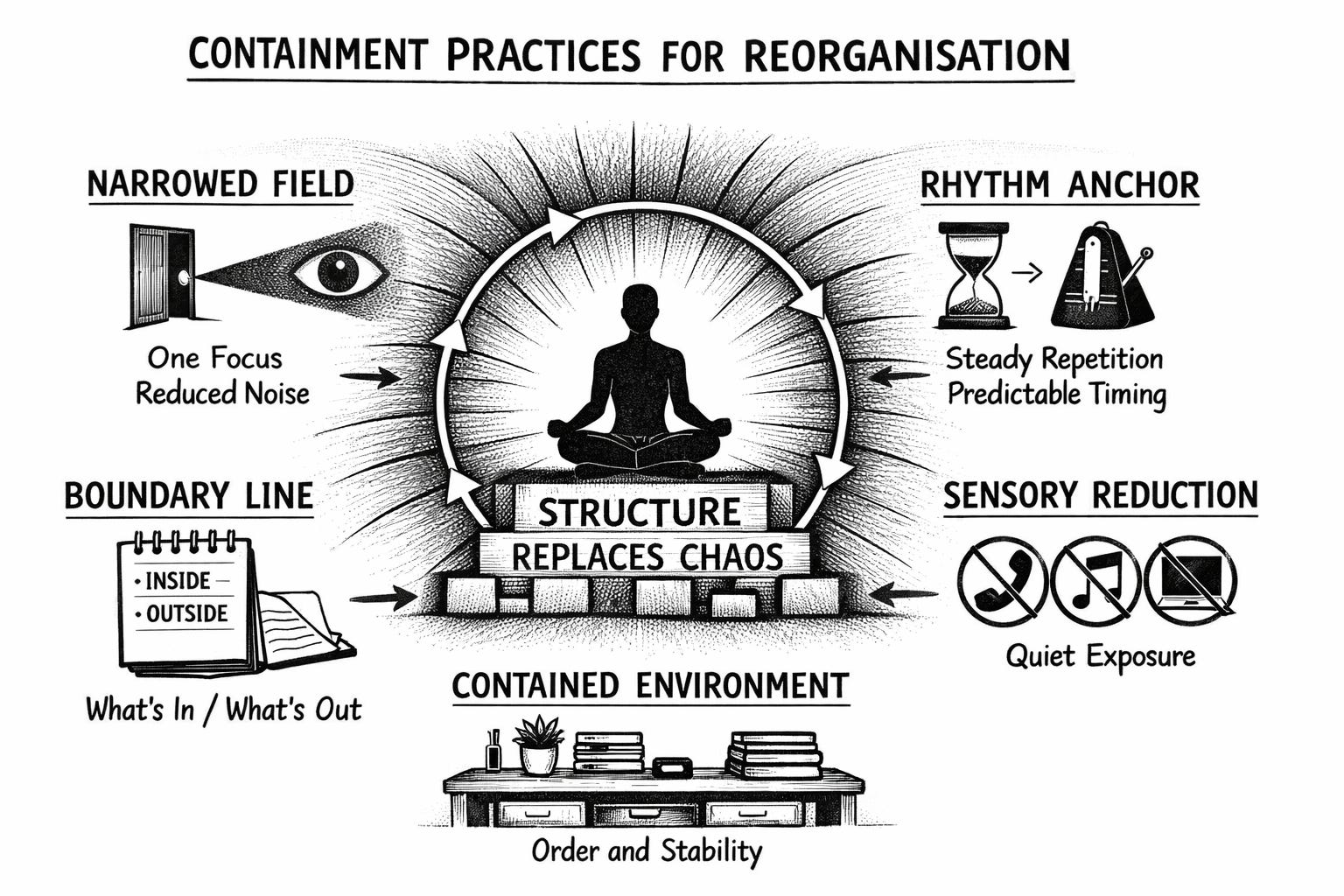
Containment is not confinement. It is the deliberate act of creating a frame strong enough for transformation to occur. When the field holds, the system remembers its own design.