


1. Core Thesis
The human nervous system is the most advanced computational system on Earth.
Modern machine‑mediated environments are beginning to garrison it — accelerating pace, fragmenting attention, and shaping interpretation.
Depth is the counter‑architecture that protects biological sovereignty.
2. The Nervous System as the Supercomputer
86 billion neurons operating in synchrony.
Processes meaning, pattern, emotion, and relational context.
No machine matches its embodied, interpretive intelligence.
It is not just a processor — it is a meaning engine.
3. Why It Is Being Garrisoned
Cognition has become infrastructure.
Machine‑paced environments pressure the nervous system into reaction.
Garrisoning happens through:
Pace escalation
Signal saturation
Emotional amplification
Predictive filtering
Attention hijacking
The nervous system becomes responsive to machine tempo rather than human tempo.
4. The Redirection of Human Cognition
Redirection is not overt control — it is environmental design.
When the environment accelerates, cognition follows.
When signals are filtered, interpretation narrows.
When emotion is amplified, behaviour synchronises.
The mind begins to operate inside conditions it did not choose.
5. Neuroscience Anchors
Theta: memory + meaning
Alpha: inhibition + focus
Delta: integration + coherence
Salience network: what the brain treats as important
Limbic system: emotional velocity vs emotional accuracy
DMN–Executive synchrony: depth, interpretation, identity
Machine‑paced environments destabilise all of these.
6. Why Depth Is the Counter‑Architecture
Depth restores oscillatory rhythms.
Depth protects salience from hijacking.
Depth stabilises limbic activation.
Depth synchronises interpretive networks.
Depth returns orientation to the inside of the mind.
Depth is not slowness — depth is sovereignty.
7. Closing Stance
The nervous system is being pressured because it is powerful.
The redirection of cognition is subtle because it is structural.
Depth is the last architecture that cannot be accelerated, hijacked, or externally governed.
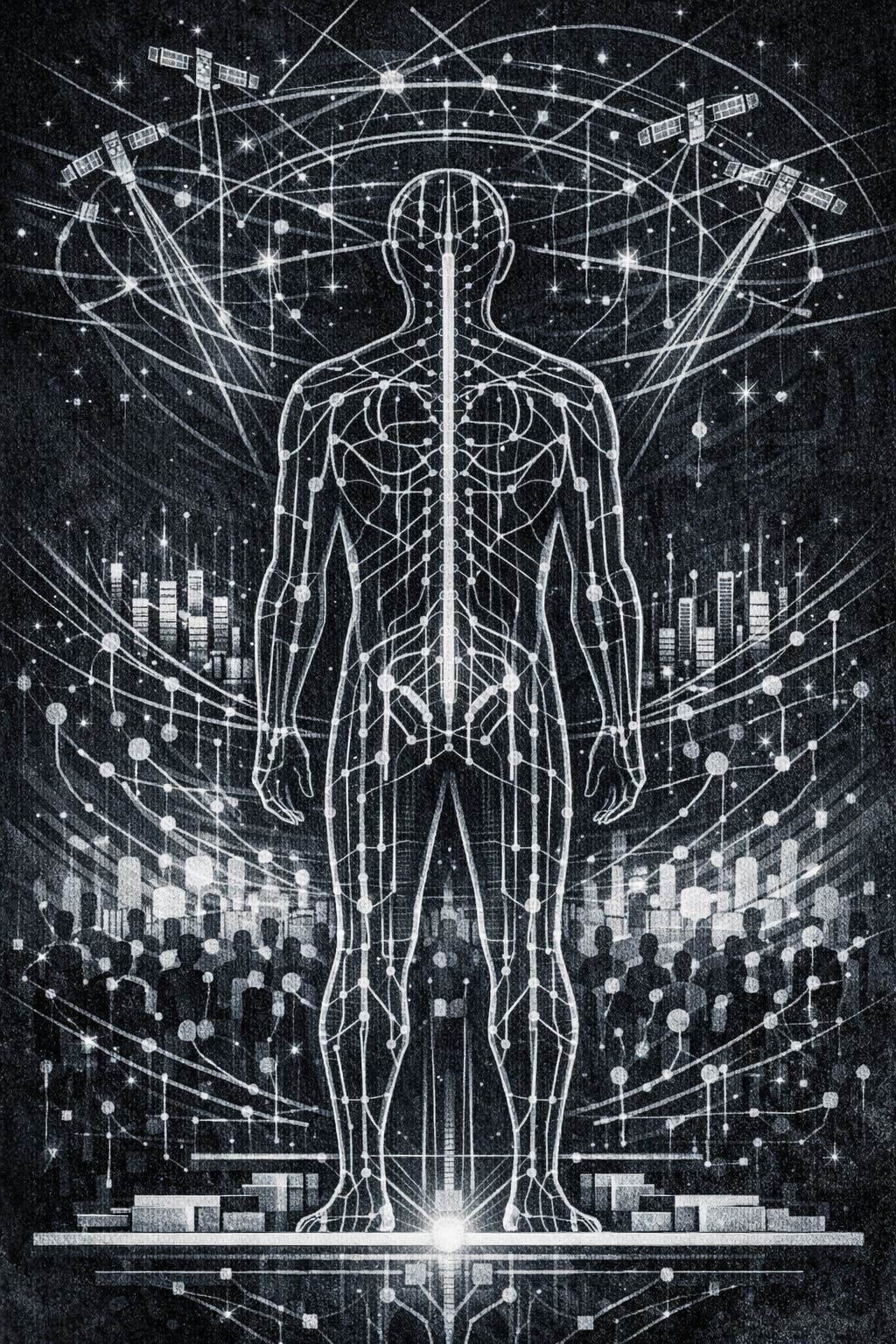
The sky is learning to think. The question is whether we still do.
Most people do not realise how quickly their nervous system has been pulled into machine‑paced conditions. The acceleration feels normal because it is everywhere. The fragmentation feels inevitable because it is constant. The redirection feels invisible because it is structural. But the cost is real: the nervous system begins to operate on a tempo it did not choose.
This exercise is designed to interrupt that drift.
It is not therapeutic. It is not soothing. It is not about comfort. It is a short, severe recalibration that forces the nervous system back into biological tempo, restores internal salience, and re‑anchors cognition inside the individual rather than the environment.
You are not trying to relax.
You are trying to regain orientation.
The steps are simple, but the effect is architectural: they slow oscillatory rhythms, stabilise limbic velocity, and return interpretive authority to the inside of the mind. In a world where the sky is becoming a mind, this is how you keep yours sovereign.


