
The Need For Orientation
A True Story

Orientation is often mistaken for intention. People assume it is about choosing a direction, setting a goal, or declaring a desire. But Orientation has nothing to do with wanting. It is not aspirational. It is not motivational. It is not the mind deciding where it wishes to go.
Orientation is the act of placing oneself correctly within one’s own architecture.
It is the moment the internal structure is acknowledged as the primary reference point, not the external world. It is the refusal to distort oneself to match an inherited architecture that is incompatible. It is the recognition that movement only becomes coherent when it emerges from alignment with one’s actual design, not from compliance with external expectation.
This act has consequences.
When you orient correctly, you lose access to certain forms of belonging. You become illegible to systems that rely on distortion for participation. You step out of roles that were only sustainable through self‑betrayal. You stop performing the version of yourself that made other people comfortable. This is the cost: the good, the bad, the ugly, and the neutral.
The good: movement becomes clean. Decisions stop fracturing you. The nervous system quiets because it is no longer forced to hold contradictory structures.
The bad: the world does not always welcome people who refuse distortion. Some doors close. Some systems eject you.
The ugly: you see, with unbearable clarity, how much of your previous life required misalignment to function.
The neutral: the architecture simply is what it is. Orientation does not create a new self; it reveals the one that was already there.
Orientation is not desire. It is fidelity.
And fidelity, once chosen, determines the only direction the system can move.
What Becomes Available Only After Orientation
Once a person is correctly placed within their own architecture, something emerges that cannot be accessed through intention, desire, discipline, or will. This is the part people misunderstand because they assume movement is something they must generate. But coherent movement is not produced; it is released.
Orientation unlocks the system’s native trajectory.
Every architecture has a direction built into it — a structural vector that exists whether the person acknowledges it or not. When someone is misaligned, that vector is obscured by noise: compensations, distortions, inherited expectations, and the gravitational pull of external structures. They cannot sense where their system is trying to move because they are standing in the wrong place inside themselves.
Correct placement removes the interference.
This is the moment when the architecture begins to reveal its actual direction. Not the direction the person hoped for, or the one they were taught to pursue, or the one that would be socially convenient — but the direction that is structurally true.
This is where the consequences begin to differentiate:
Good: clarity becomes non‑negotiable. The system stops tolerating what contradicts its design.
Bad: the person can no longer pretend not to know.
Ugly: structures that depended on their distortion begin to destabilise.
Neutral: some paths simply cease to exist, not as losses but as impossibilities.
Orientation does not create new options.
It reveals which options were never structurally available in the first place.
And this is the point:
intention and desire cannot override architecture.
They can only obscure it.
Orientation removes the obscurity.
Once Orientation is complete, movement stops presenting itself as a decision. It arrives as a fact. Not a preference, not a plan, not a hope — a structural inevitability. The system begins to move in the direction it was already built to go, and the person experiences this not as motivation but as a kind of internal alignment that removes the need for negotiation.
Coherent movement has a particular texture.
It is quiet.
It is unforced.
It does not ask for permission.
It does not seek validation.
It does not require the mind to generate momentum.
It is the sensation of no longer pushing against your own internal walls.
There is no drama in it.
No surge.
No epiphany.
Just the absence of resistance.
This is why coherent movement cannot be accessed through desire or intention. Desire is often a reaction to misplacement. Intention is often an attempt to compensate for internal noise. But once the architecture is correctly oriented, the noise drops out. What remains is direction — not chosen, but revealed.
And this revelation has consequences that are not moral or emotional, but structural. Some things fall away because they no longer have anything to attach to. Some dynamics collapse because they depended on your misalignment to function. Some possibilities become inert because they were never structurally viable, only temporarily maintained through distortion.
Coherent movement is not about becoming a different person.
It is about ceasing to obstruct the person you already are.
It is the moment the architecture stops contorting and begins to act according to its own design.
When I talk about Orientation as a structural act, I am talking about what is happening in my life right now.
These are not abstractions.
These are the collisions I am in with institutions that cannot hold my architecture.
And the only reason anything has moved at all is because I refused to collapse myself into the positions they tried to assign me.
The NHS spent years insisting on a version of my clinical reality that was convenient for them and incompatible with me. They wanted me to accept misclassification, minimisation, and a narrative that kept their processes intact at the expense of my health.
I refused.
I refused to accept their downgraded interpretation.
I refused to pretend their omissions were harmless.
I refused to participate in the fiction that “nothing was wrong” simply because they could not hold what was true.
And because I refused, and had agency, they were forced to confront their own architecture.
They were forced to look at the record they had been avoiding.
They were forced to acknowledge the deterioration they had ignored.
The result:
a formal admission of years of medical negligence.
Not because they volunteered it.
Not because the system suddenly became ethical.
But because my refusal made their position untenable.
This is Orientation:
standing in the correct place inside my own clinical architecture until the external structure has no choice but to adjust.
Winchester City Council is another live example. A system built on procedural contradiction, where responsibility evaporates the moment you try to locate it. They rely on confusion as a stabilising mechanism. They rely on people giving up.
I do not.
I do not pretend their processes make sense when they do not.
I do not absorb blame for failures that originate in their structure, not mine.
I do not perform the passivity they depend on to keep the machinery running.
I stay exactly where my architecture places me — clear, precise, immovable — even when their structure is collapsing under its own incoherence.
And then there is Southern Water — another structure that tried to rely on my silence, my exhaustion, my willingness to let their misconduct fade into administrative fog. They took money they were not entitled to, they ignored my complaint for months, and they attempted to bury the issue under offshore call‑centres and procedural dead‑ends.
I refused to let it disappear.
I refused to accept their non‑response as an answer.
I refused to allow their maladministration to be normalised.
I refused to let them treat the issue as trivial simply because it was inconvenient for them to address.
And because I refused, the case did not vanish.
It escalated.
CCW has now taken it on — not because Southern Water volunteered accountability, but because my refusal made their avoidance structurally impossible. CCW is now examining their failures, their delays, their mishandling, and the fact that they attempted to sidestep their own regulatory obligations.
This is Orientation:
remaining correctly placed inside my own architecture of accuracy until the external structure is forced to confront its own misconduct.
Delay
All three examples used delay as a tactic.
Delay is not accidental.
It is a structural feature.
It is designed to exhaust, to confuse, to make you doubt your own clarity.
I do not interpret their delay as my impatience.
I do not interpret their confusion as my misunderstanding.
I do not interpret their dysfunction as my failure to cope.
I recognise delay as a property of their architecture, not a flaw in mine.
This is what refusal looks like in real time:
not dramatic, not emotional — simply the act of standing in the correct place inside my own design and refusing to move into positions that would require distortion.
I am not pretending any of this is easy.
Refusal is not comfortable.
Correct placement is not painless.
Orientation is not a romantic act of self‑actualisation.
It is a structural demand that costs something every single time.
And I know exactly what the alternative looks like.
The Alternative Is Winston Smith
I am not pretending that any of this is easy.
Refusal costs something.
Correct placement costs something.
Standing inside my own architecture when the system demands distortion costs something.
But I know what the alternative looks like.
The alternative is Winston Smith at the end of 1984 — not the political symbol, not the literary reference, but the human being who has been bent so completely out of shape that he can no longer locate himself inside his own structure.
The man sitting alone in the Chestnut Tree Café, gin‑soaked tears rolling down his cheeks, emptied out, rewritten, and returned to the world as a compliant instrument of the very system that annihilated him.
There is a single line that captures the totality of that collapse:
“He loved Big Brother.”
That is what it looks like when a person has been fully absorbed.
When the architecture has been broken so thoroughly that the person no longer recognises the violation.
When the distortion becomes indistinguishable from identity.
That is the cost of the alternative.
That is what happens when you allow the system to place you instead of placing yourself.
That is what happens when you collapse your architecture to fit an external structure that was never built to hold you.
I refuse that outcome.
I refuse the gin‑soaked tears.
I refuse the hollowed‑out compliance.
I refuse the quiet annihilation that institutions rely on when they cannot metabolise someone who will not distort.
Refusal is not easy.
But the alternative is Winston Smith — and I will not become that.
In the end, Orientation is not a philosophical stance. It is a neurological requirement. A system can only remain coherent if its internal models match its actual structure. When those models are forced to bend to external architectures that contradict them, the brain enters a state of chronic prediction error — a continuous loop of mismatch between what the system knows and what it is being asked to perform.
That mismatch is not psychological.
It is physiological.
It is metabolic.
It is structural.
A nervous system cannot sustain prolonged distortion without consequence.
The cost is cumulative: cognitive load, sensory overload, autonomic dysregulation, the slow erosion of self‑generated signal under the weight of imposed noise.
Orientation is the act that stops that erosion.
It is the moment the internal model is allowed to align with the actual architecture rather than the demanded one. It is the restoration of accurate prediction, accurate mapping, accurate self‑location. It is the nervous system returning to a state where it can trust its own signal.
This is why refusal is not defiance.
It is homeostasis.
This is why standing in the correct place inside my own architecture is not a choice.
It is the only way the system can maintain coherence.
The alternative is not metaphorical.
It is neurological collapse — the point at which the internal model has been overwritten so thoroughly that the system begins to treat distortion as truth. That is what the final image of Winston Smith represents: not political defeat, but the total replacement of an internal architecture with an external one.
I know exactly what that costs.
I know exactly what it destroys.
And I know exactly why I cannot allow it to happen in me.
Orientation is the act of keeping the internal model intact.
It is the act of maintaining fidelity to the architecture I actually have.
It is the act of refusing to let external structures rewrite the neural scaffolding that holds me together.
This is not easy.
But it is the only path that preserves coherence.
And coherence is the only condition under which I remain myself.
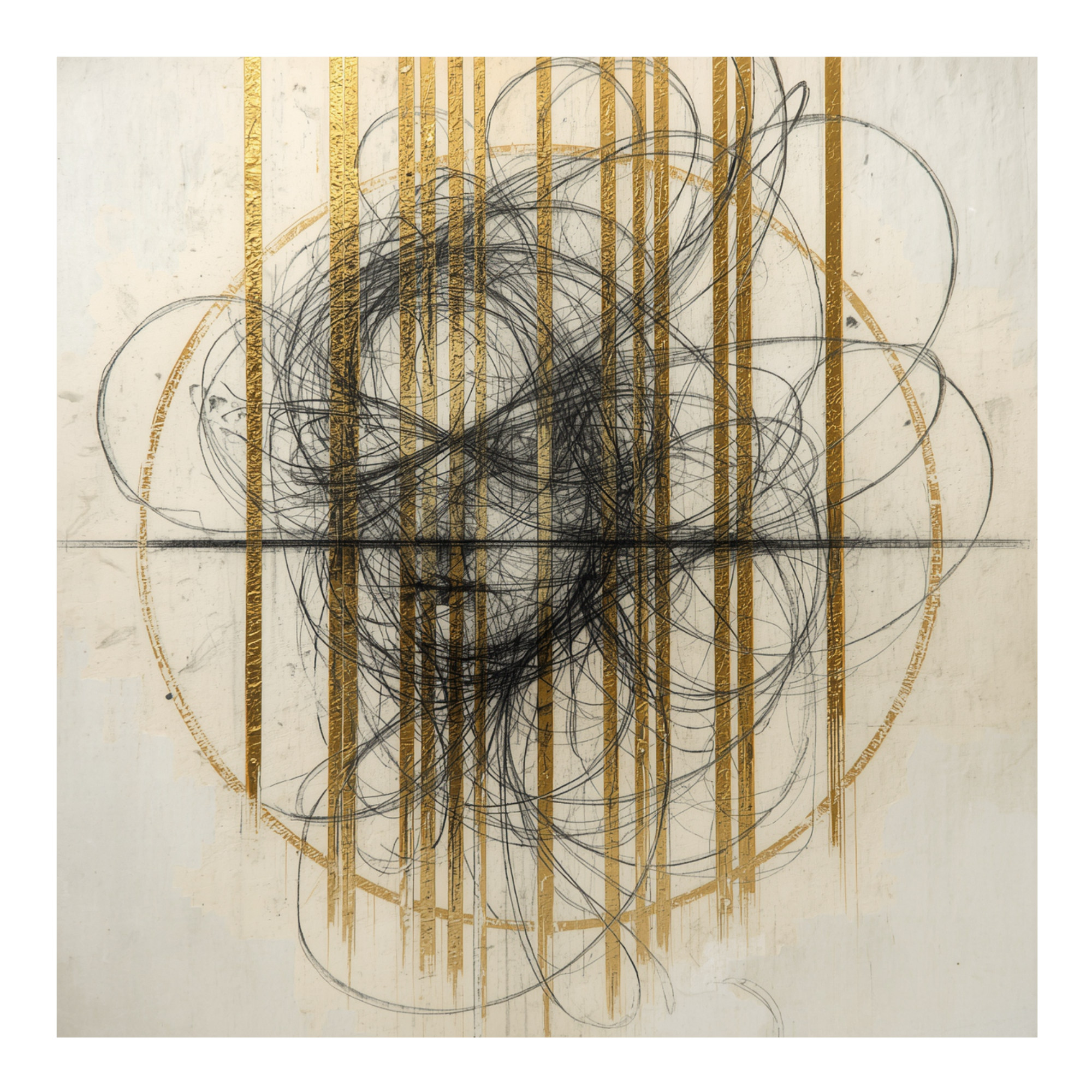
Orwell gave us Winston Smith to show the cost of collapse. I write for the people who refuse to reach the point where the tears run and the system wins.
Paid‑Subscriber Section Preface
This next section is for those of you who work at the level beneath language — the level where architecture, neurology, and lived structure intersect. The public piece ends at the point where Orientation becomes recognisable. What follows is the part that explains why Orientation is non‑negotiable for a system like mine, and for many of yours. This is the layer that sits inside the nervous system itself: prediction error, internal models, metabolic load, and the cost of distortion.
