
The Neural Mycelium
April Architecture of Resilience

In the first movement of April, we focused on the individual architecture of the stem—the process of hardening off our internal landscape against the wind of the world. However, as we move deeper into this month of structural growth, we must acknowledge a fundamental biological truth: no architecture exists in isolation. To truly understand resilience, we must look beneath the surface at the Neural Mycelium.
The Intelligence of the Network
In the natural world, the health of an ecosystem is governed by the mycelial network—a vast, fungal web that connects the root systems of various species. This network is not a passive structure; it is an active, intelligent system that facilitates the exchange of nutrients, warns of impending threats, and supports the weaker members of the community.
Our central nervous system operates as our personal mycelium. It is the interface through which we connect with the external world and the collective. Yet, in our modern landscape, this network is often under assault. We are frequently encouraged to be perpetually available, connected to every digital signal and every social demand. This leads to a state of systemic over-extension where our neural architecture becomes thinned and fragile.
The Biology of Synaptic Pruning
To maintain the Architecture of Resilience, the nervous system must practice a process known as Synaptic Pruning. During periods of rapid growth, the brain produces an excess of neural connections. To ensure efficiency and structural integrity, the system must eventually identify which pathways are redundant or parasitic and allow them to wither. This is not a loss; it is an essential refinement.
When we fail to prune our internal network—when we remain connected to toxic environments, frantic digital cycles, or draining social obligations—we prevent our nervous system from consolidating its strength. We are left with a high-noise, low-nutrient network that cannot support the weight of our potential. Stewardship of the Neural Mycelium requires us to be as rigorous with our connectivity as we are with our boundaries.
Discerning the Parasitic from the Nutritious
Resilience is a networked achievement.
This week, we are invited to conduct a formal audit of our connectivity.
We must distinguish between connections that are nutritious—those that offer a genuine exchange of minerals, support, and wisdom—and those that are parasitic.
Nutritious Connectivity: These are relationships and environments that regulate the nervous system, providing the safety required for the Ventral Vagal bloom to persist even in challenging conditions.
Parasitic Connectivity: These are stimuli that keep the system in a state of chronic high-tone sympathetic arousal, demanding attention without offering any metabolic or emotional return.
By refining our network, we ensure that our energy is not dissipated into the void of the collective, but is instead concentrated into the structures that sustain us. We do not seek to be disconnected; we seek to be intelligently connected.
A Reflection
If you were to view your attention as a finite biological nutrient, where are you currently over-investing?
Which pathways in your Neural Mycelium are no longer serving your architecture, and how might you begin the process of pruning them?
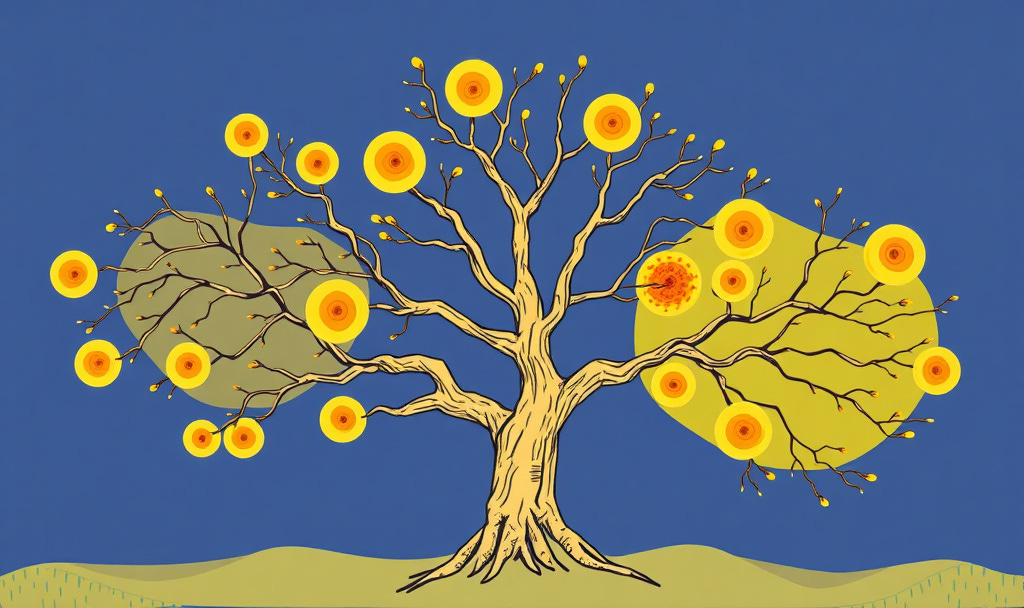
The strength of the individual is a myth of the isolated ego. In the biological reality of the forest, the tree that stands alone is the first to fall. True resilience is found in the sophistication of our networks—in our ability to discern which signals to amplify and which to mute. We do not just grow upward; we grow together, woven into an invisible intelligence that knows exactly how much we can carry.