

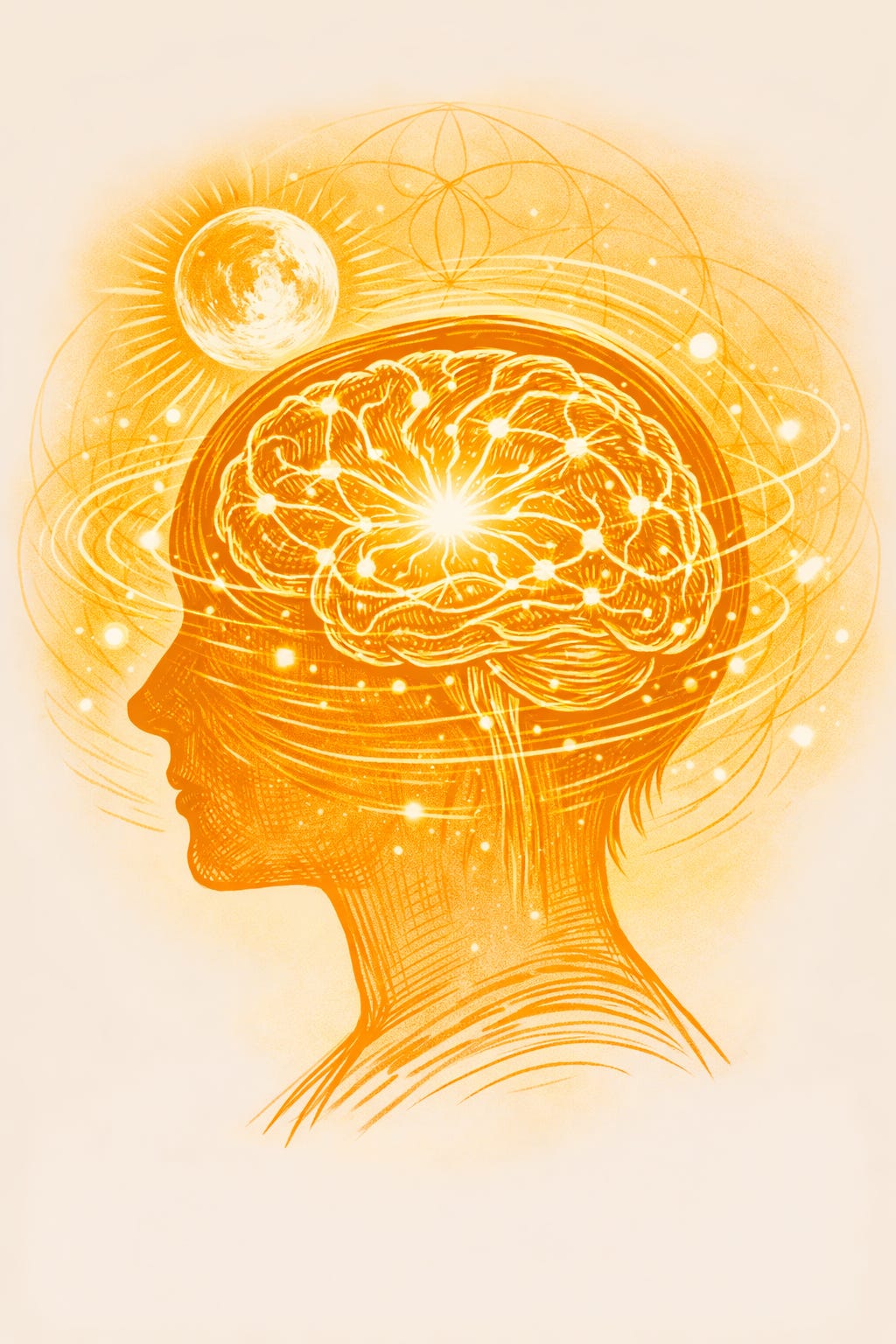
This piece explores the waning gibbous as a biological and psychological integration phase — a moment when the nervous system shifts from intensity to assimilation.
After the full‑moon peak, the body enters a resonance window where environmental stability and softened light support down‑regulation, allowing meaning to settle rather than scatter.
Through a neuroscientific lens, this work examines how the human system processes experience, how coherence emerges when stimulation decreases, and why insight becomes possible only when the body recognises safety.
These notes guide through the architecture of this phase, offering a framework for understanding integration as a physiological event rather than a cognitive task.
1. Context: Resonance Window
Stable air and softened light create environmental conditions that support down‑regulation.
This lunar phase aligns with a neurological “resonance window” where the system becomes receptive rather than reactive.
2. Core Neuroscience
The nervous system transitions from sympathetic intensity toward parasympathetic coherence.
The prefrontal cortex re‑engages, enabling synthesis rather than analysis.
The default‑mode network activates in a balanced way, supporting reflection without rumination.
Environmental cues — reduced light contrast, moderated temperature, atmospheric steadiness — signal safety, allowing meaning to settle.
3. Integration as a Biological Process
Integration is not cognitive effort; it is physiological permission.
Meaning settles only when the system is no longer bracing against intensity.
The waning gibbous provides the conditions for experiences to be metabolised into understanding.
4. The Softening
This phase offers a gentle descent from heightened activation.
The body shifts from amplification to assimilation.
Insight emerges naturally when the system recognises it is safe enough to receive it.
5. Application
Honour the integration window by slowing pace and reducing stimulation.
Allow reflection to arise without forcing interpretation.
Use this softened phase to consolidate emotional, cognitive, and relational experiences.
Meaning does not arrive through revelation; it stabilises through regulation. The coherent brain does not chase truth — it becomes the environment in which truth can finally rest.


