
Welcome to May
The Beginning of the Depth

May marks the point where resilience gives way to depth. After a period focused on establishing boundaries, stability, and structural integrity, the next phase moves below the surface.
Depth begins when the external architecture is strong enough to support sustained inward movement.
This stage is defined by clarity, containment, and the disciplined navigation of uncertainty.
It is not a descent into difficulty but an intentional entry into the layer where underlying patterns, principles, and truths become visible.
May initiates this shift: from holding shape under pressure to exploring what that shape makes possible.
Depth requires a stable container because its work is not reactive but investigative.
Once the outer architecture is established, attention can shift to the underlying patterns that shape behaviour, meaning, and direction.
This phase examines what persists beneath surface adaptation: the assumptions that drive action, the structures that hold identity in place, and the forces that operate when certainty is removed.
The purpose of entering the depth is not to resolve these elements quickly but to observe them with clarity, allowing a more coherent framework to emerge.
May initiates this analytical descent, creating the conditions for insight that cannot be accessed from the surface.
Underlying patterns, principles, and truths become visible in the depth because depth removes the conditions that normally obscure them.
When surface activity, external demands, and habitual responses fall away, what remains is the structural logic that governs a system from within. Depth creates a form of perceptual compression: fewer variables, slower movement, and reduced noise.
In this environment, recurring motifs stand out, foundational principles reveal their influence, and truths that were previously diffused across experience become concentrated and recognisable.
The value of this phase lies in its diagnostic clarity; it exposes the organising forces that shape behaviour, coherence, and direction, allowing them to be examined without distortion.
When underlying patterns, principles, and truths become visible, they create the conditions for coherent change. Visibility transforms depth from a passive state into a generative one: once the organising forces of a system can be seen clearly, they can be evaluated, refined, or replaced with intention.
This clarity enables more precise decision‑making, more accurate alignment between structure and purpose, and a more stable foundation for future development.
The emergence that follows depth is not a return to the previous state but the formation of a new configuration shaped by what has been revealed.
In this way, depth functions as a necessary precursor to any meaningful reorganisation or ascent.
How you can enter the depth and make underlying patterns visible
Depth is not accessed through intensity or introspection but through conditions.
When the right conditions are created, depth becomes a natural consequence rather than an effortful pursuit.
There are three conditions that enable this:
1. Reduce surface activity
Depth becomes accessible when the field is no longer dominated by noise, urgency, or habitual response.
You can create this condition by:
simplifying inputs
reducing reactive cycles
limiting unnecessary decision‑making
establishing predictable rhythms
This reduction is not withdrawal; it is clearing the surface layer so deeper structures can be perceived without interference.
2. Establish a stable container
Depth requires containment — a structure that holds shape while attention moves inward.
You create containment through:
consistent routines
clear boundaries
defined limits on energy expenditure
predictable frameworks for daily movement
Containment prevents diffusion.
It ensures that when depth opens, it does so within a coherent architecture rather than into collapse.
3. Slow the pace of interpretation
Patterns, principles, and truths become visible when observation is allowed to precede meaning‑making.
You can do this by:
pausing before assigning significance
allowing repeated experiences to accumulate
watching for recurrence rather than novelty
noticing what remains stable across contexts
This shift from immediate interpretation to pattern recognition is what reveals the underlying structure of a system.
What this enables
When these three conditions are in place:
surface noise decreases
structural forces become visible
recurring motifs stand out
foundational principles reveal their influence
truths that were previously diffused become concentrated
This is how depth becomes diagnostic rather than emotional.
It is how you gain access to the architecture that shapes your behaviour, coherence, and direction.
Depth Access Protocol
A simple, repeatable model anyone can use.
Step 1 — Clear the surface
Goal: Reduce noise so anything deeper can be noticed.
Do:
List: Write down all current inputs (notifications, apps, meetings, calls, social, news).
Remove: Turn off non‑essential notifications for a set period (e.g. one week).
Simplify: Drop or postpone low‑stakes, non‑essential tasks.
Limit: Choose fixed windows for email/messages instead of constant checking.
Step 2 — Build a basic container
Goal: Create a stable, predictable frame.
Do:
Set times: Fix waking, sleeping, and one daily anchor activity (walk, reading, etc.).
Define boundaries: Decide when you are available/unavailable each day.
Protect blocks: Reserve one small, uninterrupted block (15–30 minutes) daily for quiet work or reflection.
Repeat: Keep this frame the same for at least 7–14 days.
Step 3 — Shift from reacting to observing
Goal: Let patterns appear instead of immediately acting on everything.
Do:
Pause: When something happens, wait a few breaths before responding.
Note: Briefly jot what happened and how you reacted (one or two lines).
Hold: Resist the urge to explain or fix; just record.
Collect: Do this across days without analysing yet.
Step 4 — Look for what repeats
Goal: Make underlying patterns, principles, and truths visible.
Do:
Review: After 7–14 days, read your notes in one sitting.
Mark: Highlight anything that repeats (situations, reactions, thoughts, tensions).
Group: Cluster similar items together.
Name: Give each cluster a simple label (e.g. “over‑commitment”, “avoidance”, “clarity”, “energy drop”).
These clusters are your patterns and organising principles.
Step 5 — Hold clarity before changing anything
Goal: Let the structure stabilise before acting.
Do:
Sit with it: Keep the same container and reduced noise for another 7–14 days.
Watch: See if the same patterns persist or shift.
Refine: Adjust labels if needed; keep them minimal and accurate.
Then act: Only after this period, choose one small, structural change aligned with what you’ve seen (e.g. saying no once, moving one boundary, changing one recurring commitment).
What you will notice if you follow the model
1. Surface noise decreases
When inputs are reduced and routines stabilise, the field becomes quieter.
A person typically notices:
fewer reactive impulses
less urgency
less fragmentation
more continuity across the day
This is the first indicator that the surface layer is no longer dominating perception.
2. Recurring patterns stand out
With reduced noise and slower interpretation, repetition becomes visible.
A person begins to see:
the same thoughts appearing in different contexts
the same behaviours triggered by different events
the same tensions or resistances repeating
the same strengths or preferences showing up consistently
These repetitions were always present; the model simply makes them legible.
3. Structural forces become identifiable
Once patterns are visible, the underlying organising principles begin to reveal themselves.
A person may notice:
what consistently drives their decisions
what stabilises them
what destabilises them
what they protect, avoid, or prioritise
what remains constant regardless of circumstance
This is the point where “truths” become observable as structural facts, not interpretations.
4. The system becomes easier to read
As visibility increases, complexity decreases.
A person often experiences:
clearer distinctions between signal and noise
faster recognition of what matters and what doesn’t
a more coherent sense of what is actually happening
less confusion, because the architecture is now visible
This is not clarity as a feeling; it is clarity as pattern recognition.
5. Decision‑making becomes more precise
Once the organising forces are visible, decisions require less effort.
A person notices:
fewer internal contradictions
more alignment between intention and action
reduced over‑correction
a shift from reacting to choosing
This is the functional outcome of depth: coherence.
6. The system begins to reorganise itself
Depth is diagnostic first, but once clarity stabilises, reorganisation begins naturally.
A person may observe:
certain behaviours dropping away without force
certain boundaries becoming non‑negotiable
certain priorities becoming obvious
certain commitments no longer fitting the structure
This is not transformation through effort; it is transformation through accurate visibility.
When you follow this model, you will begin to see the architecture of your own system — and once the architecture is visible, it becomes workable.
I have been following these protocols myself, and I know the discipline they require. Stripping away noise, reducing activity, and refining the container is not comfortable work; it exposes what has been obscured and removes the familiar distractions that make avoidance easy.
But this refinement is essential.
It is the only way to create the conditions in which the deeper architecture becomes visible.
The process is demanding, but it is also exact: when the unnecessary is removed, what remains is the structure that allows a person to become who they were born to be — not through effort, but through alignment with what is fundamentally true.
As this phase begins, the work is simply to hold the structure long enough for it to reveal what it contains.
Depth is not a dramatic state but a disciplined one, and its value comes from the clarity it produces when the unnecessary is removed.
The protocols exist to make that clarity possible, and the refinement they require is the cost of coherence. What follows in May is not a descent for its own sake, but the deliberate creation of the conditions in which a person can meet the architecture of their own life without distortion.
This is the foundation for everything that comes next.
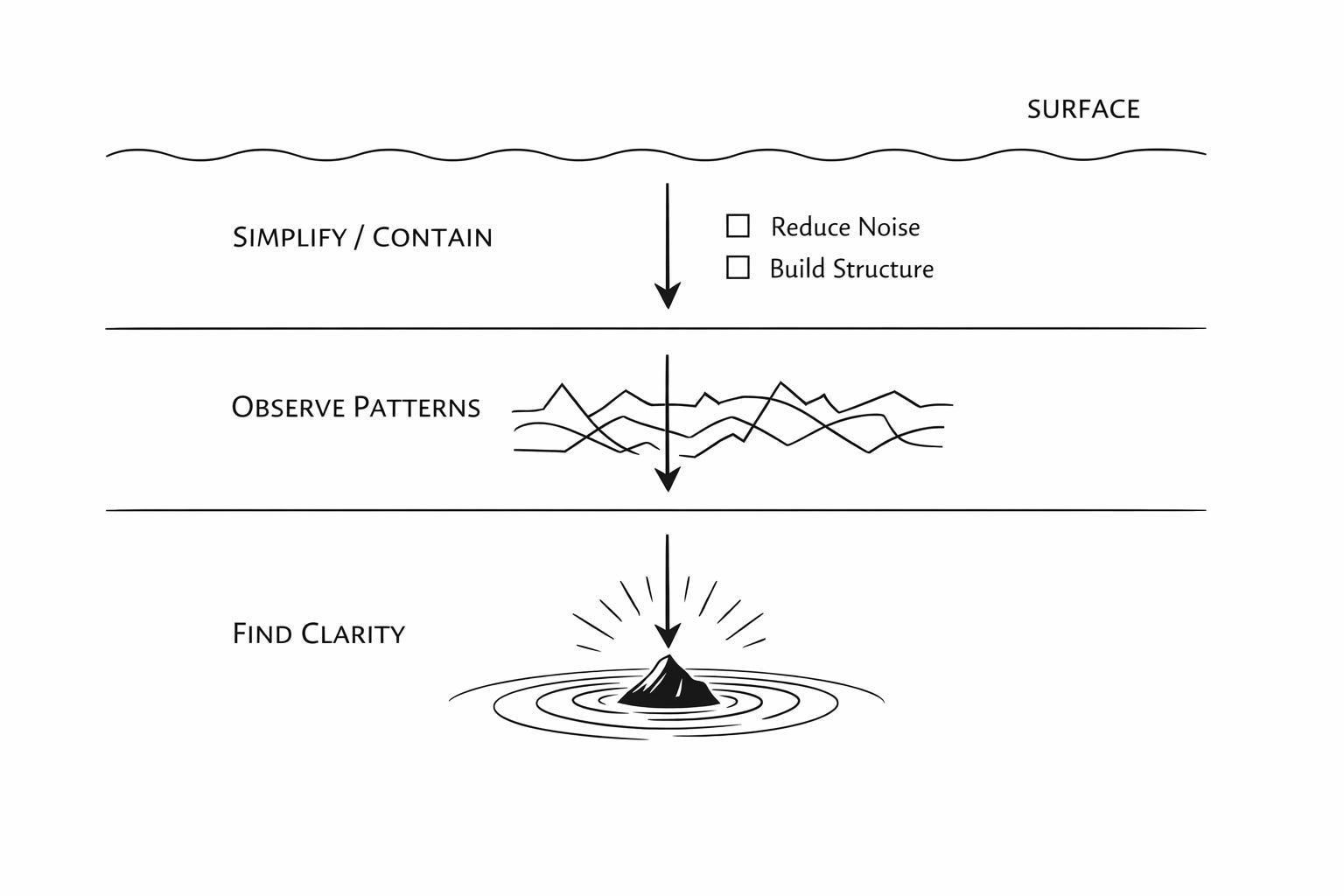
Depth is not discovered; it is built. When the unnecessary is removed, what remains is the structure of truth — and within that structure, a person becomes who they were born to be.