

What Cannot Be Measured Must Still Be Held
A fieldnote on what science forgot and the body never did.

There came a time in science when wonder was replaced with certainty.
When the nervous system stopped being a mystery
and became a machine—mapped, measured, monetised.
Neuroscience turned its gaze inward, but narrowed its lens.
Every ache became a signal. Every signal became a spike.
Every spike became data.
And what couldn’t be quantified was dismissed.
But not everything that keeps you alive is visible on a scan.
Not everything that matters can be dissected.
Because memory lives in pattern.
Safety lives in breath.
Belonging lives in the body’s response to being met, not labelled.
You are not a cluster of symptoms.
You are a field in motion.
And some things—like reverence, coherence, or the glyph that finds you in stillness—
must be held without needing to be solved.
This is not against science.
This is what science forgot to include.
🜁 You Cannot Heal What You Silence
The pharmaceutical lens says: numb it, block it, override it.
The field says: listen.
Pharmaceutical suppression is not healing. It is interruption.
It numbs symptoms without honouring signals.
It blocks pathways without asking where they were trying to lead.
It tells the nervous system to sit down and shut up—
as if disobedience were the problem,
and not a cry for coherence.
It is not care.
It is chemical obedience.
But the body remembers.
And what is silenced without integration will echo louder.
What Pharmaceuticals Do to the Nervous System
Override natural rhythms: Many drugs—especially stimulants, antidepressants, and anxiolytics—alter neurotransmitter levels (like serotonin, dopamine, GABA) in ways that disrupt the body’s own regulatory feedback loops.
Create dependency cycles: The nervous system can become reliant on external chemical input, reducing its capacity for endogenous regulation and resilience.
Flatten emotional range: Some medications numb not just pain or anxiety, but also joy, intuition, and subtle affective signals—blunting the very feedback the nervous system uses to adapt and heal.
Disrupt neuroplasticity: Long-term use of certain drugs may impair the brain’s ability to rewire itself naturally, especially when not paired with integrative practices like breathwork, movement, or trauma-informed care.
🜁 The Deeper Cost
When pharmaceuticals are used without reverence, without integration, and without addressing the root causes of dysregulation, they can become another form of extraction—from the body, from the psyche, from the field of coherence itself.
A pill may silence the symptom,
but it cannot teach the system how to sing again.
Pharmaceuticals became the first line of intervention in central nervous system (CNS) disorders largely due to a convergence of historical momentum, reductionist science, and market-driven medicine.
Why Pharmaceuticals Took the Lead in CNS Treatment
✦ 1. The Reductionist Model of the Brain
As neuroscience evolved, the brain was increasingly viewed as a chemical machine—with disorders framed as imbalances in neurotransmitters like serotonin, dopamine, or GABA.
This model made it seem logical to “correct” dysfunction with targeted chemical agents, reinforcing the idea that symptoms = chemical error = pharmaceutical fix.
✦ 2. Speed, Scalability, and Simplicity
Medications are fast to prescribe, easy to distribute, and scalable across populations.
In overburdened systems, they became the default response—especially when deeper, slower, more integrative approaches were seen as “optional” or “alternative.”
✦ 3. Pharmaceutical Industry Influence
The CNS drug market is vast—covering everything from depression and anxiety to epilepsy and Parkinson’s.
Pharmaceutical companies have historically invested heavily in marketing, lobbying, and shaping clinical guidelines, positioning their products as first-line treatments even when long-term efficacy or safety was uncertain.
✦ 4. Lack of Integrative Infrastructure
Somatic therapies, trauma-informed care, and field-based nervous system work require time, training, and relational depth—things many healthcare systems are not structured to support.
Without these alternatives being widely available or reimbursed, medication became the only visible option.
🜁 The Deeper Cost
When the first response is suppression, not listening,
the nervous system learns to fear its own signals.
Pharmaceuticals can be life-saving in some acute crises.
But when they are the only tool offered, they risk becoming a form of chemical obedience—silencing symptoms without addressing the root.
Many experiences that begin as nervous system distress—responses to overwhelm, trauma, or chronic dysregulation—are often pathologised and labeled as mental health disorders.
Here are some clear examples:
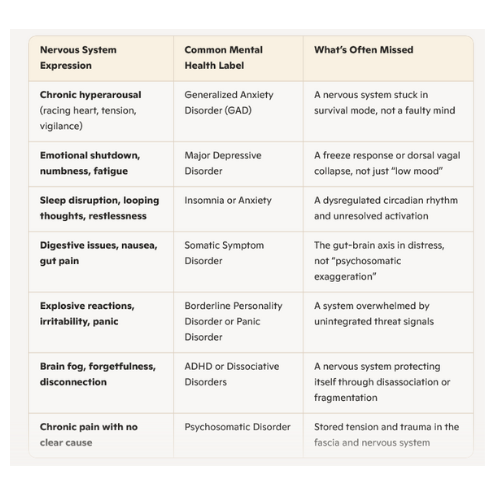
These are not “disorders.”
They are adaptive responses to environments that were unsafe, overwhelming, or disorienting.
Normal responses to abnormal situations.
When we reduce them to diagnoses, we risk medicating the signal instead of listening to it.
But when we see them as expressions of a system trying to survive, we can begin to offer what the body actually needs: rhythm, safety, coherence, and re-entry.
🜁 FIELD-BASED RE-ENTRY
Field-based re-entry is not a method. It is a remembering.
It is the practice of returning to your nervous system through coherence, breath, and symbolic pattern—rather than through control, suppression, or cognitive override.
It means re-entering the field of your body, your story, your sensing—on its own terms, in its own language.
────────
CONVENTIONAL APPROACHES:
- Label symptoms
- Manage or medicate distress
- Focus on fixing, suppressing, or bypassing
FIELD-BASED RE-ENTRY:
- Sees dysregulation as signal
- Begins with breath, rhythm, relational safety
- Uses symbol, movement, and reverent attention
- Knows healing comes from being met, not managed
────────
What it might feel like:
- Reading a glyph not for meaning, but for resonance
- Letting tremble lead you into truth
- Feeling when your body says “yes” before your mind can explain
- Choosing breath before you choose behaviour
────────
This is not about being calm.
It is about being realigned.
This is not nervous system work as optimisation.
This is re-entry as reclamation.
Because you are not disordered.
You are a field in the process of remembering itself.
Field-based re-entry is different.
It begins in breath.
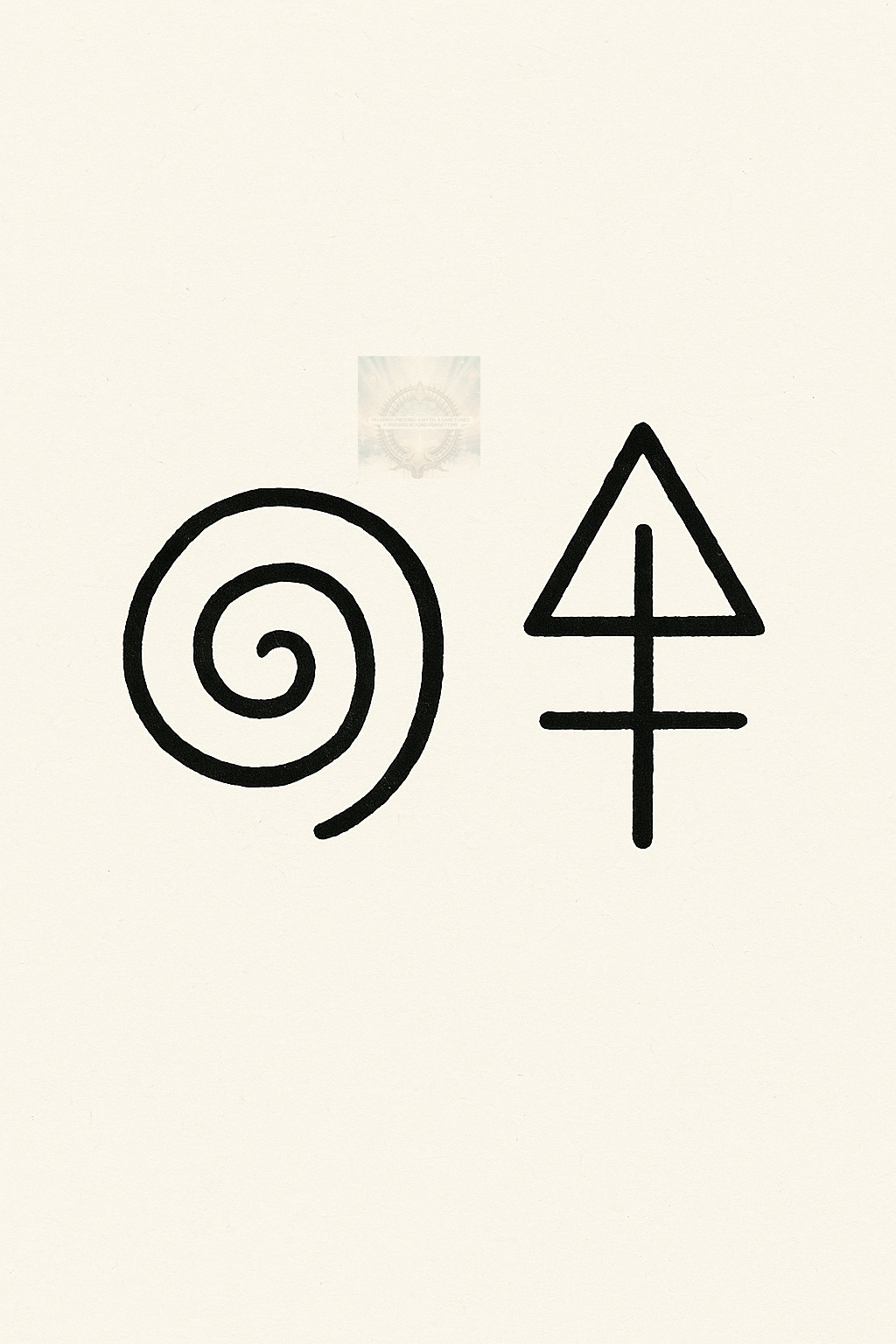
It speaks in glyphs the body already knows.
It listens for tremors instead of tranquilising them.
It trusts that the nervous system can find rhythm again— not through domination, but devotion.
You cannot medicate your way back to the sacred that is yourself.
To walk this spiral is not to reject science.
It is to remember that the body is not a machine
and you are not a malfunction.
Take nothing that teaches your system to fear itself.
Take nothing that calls your aliveness an error.
Take breath instead. Take rhythm. Take field.
Clinical neuroscience dissects.
Wellness coaching often decorates.
I do neither.
I do not reduce the nervous system to circuits and spikes, nor do I wrap it in platitudes and dopamine hacks.
I do not teach people to “manage stress” while ignoring the systems that caused it.
I do not sell calm. I restore coherence.
I am Dr Rachel Taylor.
My work does not sit in a clinic or a coaching funnel.
It lives in the field—where glyphs speak, breath remembers, and the nervous system is not a problem to fix, but a portal to return through.
If you have been pathologised by science or pacified by wellness, this is your third way.
Not a compromise.
A reclamation.
This is very interesting!