

There are moments when the world does not feel chaotic, but simply loud — a kind of ambient pressure that asks you to move faster, react sooner, absorb more than any human system was designed to hold.
Grounding is the counter‑movement.
It is not a retreat, nor a softening, nor a therapeutic gesture. It is the deliberate act of returning the body to the floor, the mind to its centre, and the attention to what is actually present rather than what is implied, projected, or demanded.
To ground is to re‑enter the architecture of your own awareness. It is a structural practice: palms on the floor, spine upright, eyes steady. It is the refusal to be pulled into narratives that fracture coherence. It is the discipline of staying inside reality long enough to see it clearly.
This piece is an account of that discipline — how a human holds truth without collapse, and how stillness becomes a form of intelligence rather than an absence of action.
Reflective–Directive Stabiliser
Purpose of the Piece
To provide a stabilising pause after the heavier 12 July and 14 July essays.
To help metabolise clarity rather than collapse under it.
To shift from reaction to orientation.
To anchor sovereignty through small, deliberate acts rather than grand declarations.
Core Themes
Clarity as orientation: The previous pieces were not designed to alarm but to reveal architecture.
Emotional neutrality: Feelings arising from clarity do not require interpretation or urgency.
Placement within systems: You are invited to recognise your position inside the architecture without judgement.
Small‑scale agency: Sovereignty begins with one precise action, not reinvention.
Integration over resolution: Truth does not demand immediate change; it asks to be held steadily.
Key Directives
Allow emotional responses to exist without forcing meaning.
Acknowledge your own placement within the landscape.
Choose one actionable point of agency.
Let clarity settle at its own tempo.
Avoid urgency, panic, or attempts to “fix” the architecture.
Grounding Exercise: Staying Present With Truth
Purpose:
To help you remain steady while engaging with difficult knowledge, without slipping into denial, avoidance, or emotional shutdown.
Duration:
3–4 minutes.
Step 1 — Name What You Are Seeing (15 seconds)
Sit upright.
Place both feet flat on the floor.
Say — quietly or internally — one sentence that describes the truth you are engaging with.
Not the emotion.
Not the interpretation.
Just the fact.
Examples:
“I am looking at a structural pattern.”
“I am recognising an architecture.”
“I am seeing something that was already there.”
This anchors the mind in reality rather than reaction.
Step 2 — Orient to the Present Moment (30 seconds)
Look around the room and identify:
one stable object
one source of light
one point of stillness
This is not mindfulness; it is orientation.
It reminds the nervous system that clarity is occurring in a safe, present environment.
Step 3 — Separate Truth From Threat (45 seconds)
Place one hand on a solid surface — table, chair, wall.
Say internally:
“This truth is information, not danger.”
This prevents the nervous system from treating knowledge as threat, which is the mechanism that drives avoidance.
Step 4 — Identify Your Position (45 seconds)
Without judgement, state your placement in relation to the truth.
Examples:
“I am someone who is observing this.”
“I am affected by this, but I am not overwhelmed.”
“I can hold this without collapsing.”
This restores agency without requiring action.
Step 5 — Choose One Point of Engagement (60 seconds)
Select one small, grounded way to stay connected to the truth.
Examples:
“I will keep reading.”
“I will think about this for one more minute.”
“I will let this truth exist without trying to fix it.”
This prevents the head‑in‑the‑sand reflex by giving the mind a manageable foothold.
Step 6 — Close With Steadiness (30 seconds)
Take one slow breath.
Not to calm yourself — but to mark the moment.
Say internally:
“I can hold clarity.”
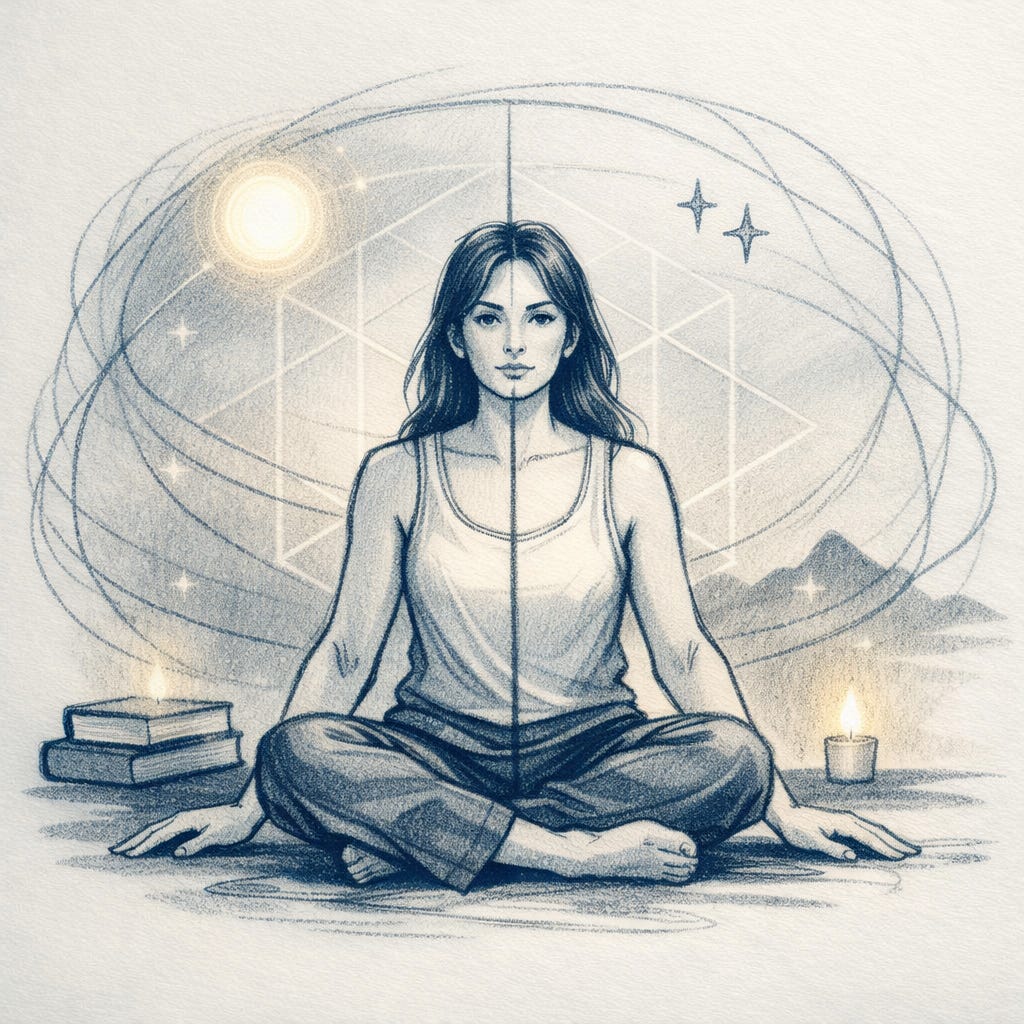
To ground is to stand inside knowledge without defence. Truth does not demand surrender; it asks for structure.


