

Core Idea
Every human system has an underlying neurobiological architecture that shapes perception, movement, and capacity. Most people feel the effects of this architecture but have never been taught to identify it directly. Naming it is the first step in understanding how their system actually operates.
Key Points Covered
Architecture precedes awareness.
Long before language, the nervous system is constructing internal models based on sensory input, relational patterns, metabolic stability, and environmental predictability.This architecture is biological, not psychological.
It is shaped by:
– predictive coding pathways
– interoceptive networks
– autonomic thresholds
– vagal tone and recovery profiles
– early relational calibration of threat‑detection circuits
– metabolic rhythms and load‑bearing capacity
Naming reveals the system’s logic.
Identifying your mobilisation patterns, stabilisation routes, recovery speed, and perceptual biases allows you to see the difference between:
– choice and constraint
– preference and prediction
– habit and neurophysiologyNaming is not interpretation.
It is not emotional analysis or psychological storytelling.
It is the recognition of structural patterns that have been operating beneath conscious awareness.Why naming matters.
When you can name your architecture, you stop misidentifying adaptive patterns as flaws.
You stop treating developmental constraints as personal failings.
You begin to understand the system you live inside.
Takeaway
Naming the architecture within is the moment the system becomes visible.
Not as pathology, not as narrative, but as the biological structure that has shaped your experience from the beginning — and can now be worked with deliberately.
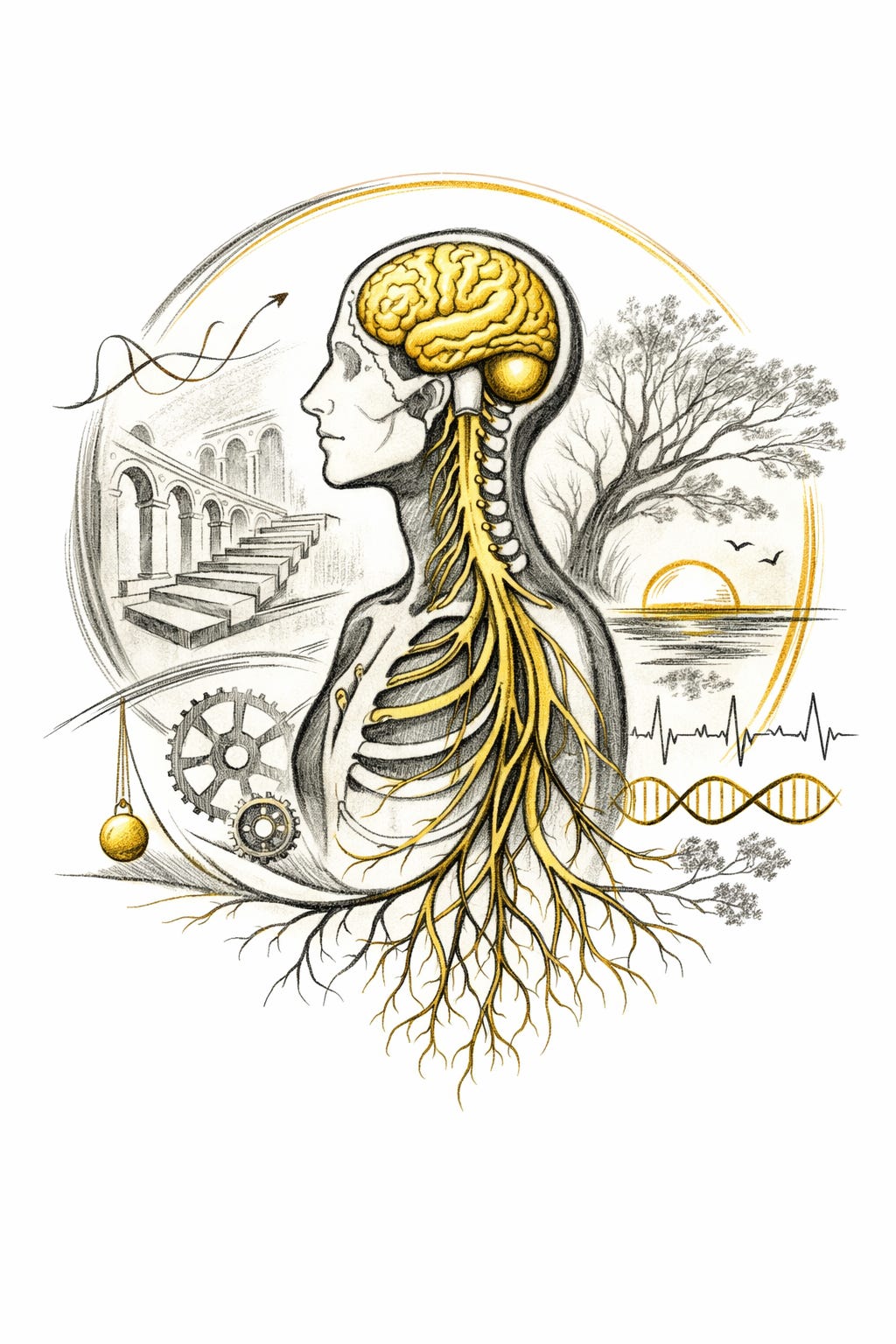
The nervous system is not a storyteller; it is a structural instrument. When you learn to name its architecture, you stop mistaking adaptation for identity and begin to see the design that has been organising you since the beginning.


